
Gratitude for Protestantism
Recognizing the good things the Protestant Reformation brought to the Christian faith and the world in general

After Roman Catholics, there are more Protestants than any other Christian faith tradition.
Estimates are that these believers make up between 33% - 40% of all Christians worldwide.1
Protestantism famously (infamously?) has thousands of denominations, although there are common patterns of belief that tie all together.
Whether non-denominational, Baptist, Methodist, Pentecostal, Lutheran, Presbyterian, or Anglican/Episcopalian, these believers hold that the Bible is the ultimate source of authority for the Christian faith and emphasize personal faith in Jesus Christ.

These denominations all grew out of the 16th century Protestant Reformation. The movement that started as an attempt to address issues in the Catholic Church and ultimately split apart the Western Church.
Some lament the split. Yet it’s undeniable that there have been many positive results, both inside and outside of the Christian faith.
One example: a marked rise in literacy rates and education.
The Rise of Mass Literacy and Education (1)
At the end of the 15th century, the literacy rate in Germany was less than 10%.
Those who could read were the elites of society: the wealthy, the clergy, and the successful merchants.
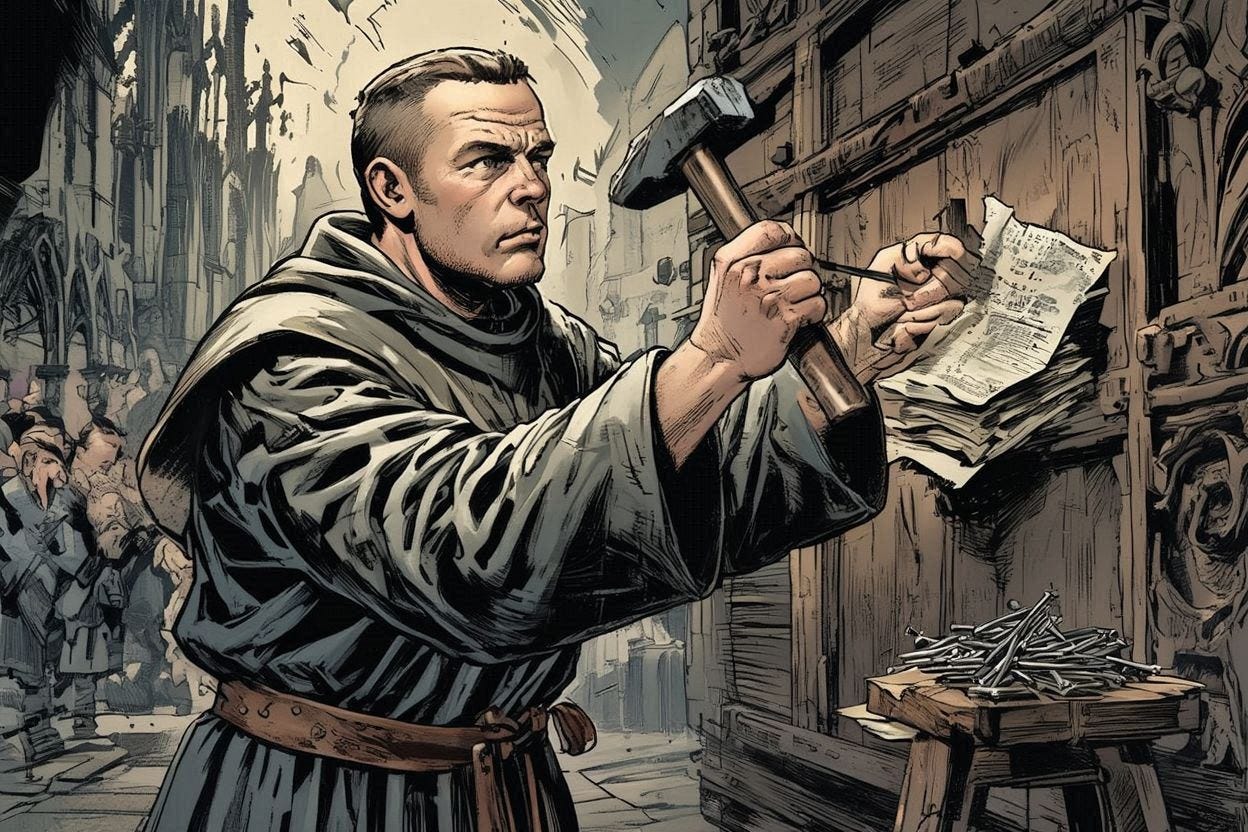
But a literary trend acquired new momentum in 1517. It was thanks to an Augustinian friar named Martin Luther who tacked up his Ninety-Five Theses to the door of Castle Church in Wittenberg and catalyzed the Reformation.2
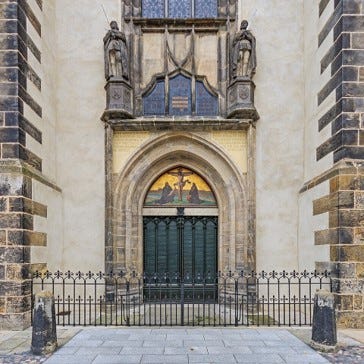

The early movements towards a growing literacy had actually started the prior century with Johannes Gutenberg and his printing press.
The press with movable type was invented in 1440, and 20 million copies of written works would be produced in Western Europe before the century was over.3
In the 16th century the printing output rose dramatically to an estimated 150 million - 200 million volumes.
Many of them were works written by Luther, the most widely read author of the 16th century.
Luther the Writer
Luther produced some 600 written works during his lifetime.4
Forty-five of them were produced in the first 3 years of the Reformation when Luther laid down the theological convictions and principles that became foundational to Protestantism.
In addition to those Ninety-Five Theses, which he had intended to start an academic debate rather than catalyze a split with Rome, here are a few more of his greatest hits.
The Freedom of a Christian (1520) which outlined Luther’s theological conviction that justification came by faith alone.
To The Christian Nobility of the German Nation (1520) in which he argued for the “priesthood of all believers” (more on that below) and directly attacked the power of the Roman Catholic papacy.
The Babylonian Captivity of the Church (1520) where he opposed the seven sacraments of the Catholic Church and instead argued for only three (baptism, penance, the Eucharist).
The German New Testament (1522) which Luther originally produced in eleven weeks during his time in exile / hiding in Wartburg Castle. Luther’s German version was based on Erasmus’ 1516 Greek translation from Byzantine manuscripts and a full Bible would follow by 1534.
His works were read 30 times more than any of his rivals and 10 times more than any other author in Germany.5 Some estimates say that up to a third of all reading at this time was of something written by Luther.6
And the impact went far beyond religious debate.
That German Bible translation directly led to the creation of the public school system. Two years after the New Testament translation, Luther penned “To the Councilmen of All Cities in Germany That They Establish and Maintain Christian Schools.”
It was a call for local authorities to institute mandatory education, and a challenge to the educational dominance of the church.
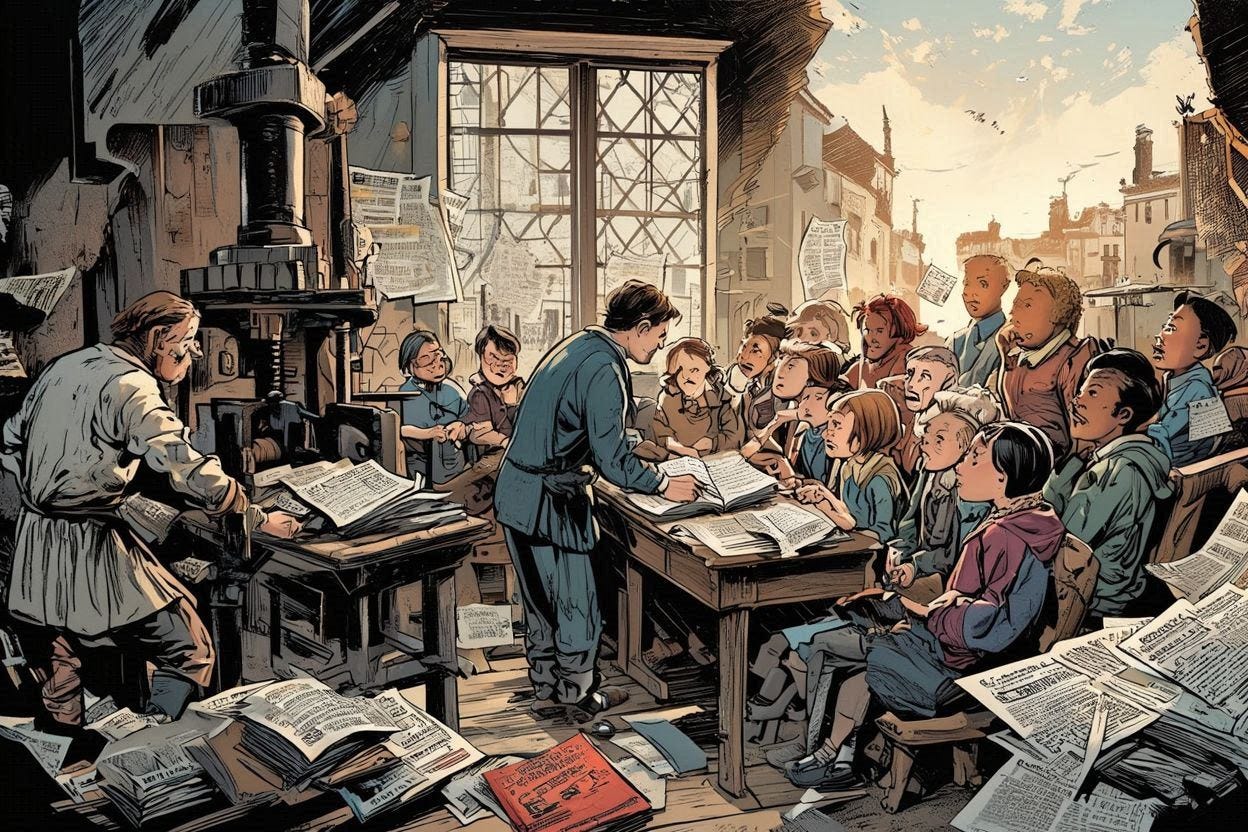
The increased knowledge and rising literacy would spread and grow throughout Europe. The monopoly that the clergy had once had on religious knowledge would be a thing of the past.
Everyone needed to read the Bible because, according to Luther and the Reformers, it was the ultimate source of authority for the Christian.
The Priesthood of All Believers and the Foundation of Democracy (2)
Before the Reformation, few in the Western Church doubted that the Sacred Tradition of the (Catholic) Church was just as authoritative as the Bible.
In a practical sense, many considered the Church had more authority than the Bible.7
The doctrine of Papal infallibility wouldn’t be Catholic dogma until the First Vatican Council of 1870, but even in the 16th century the Pope had final rights to interpret both Scripture and Tradition.
For Luther and the other Reformers, authority was in Scripture alone.
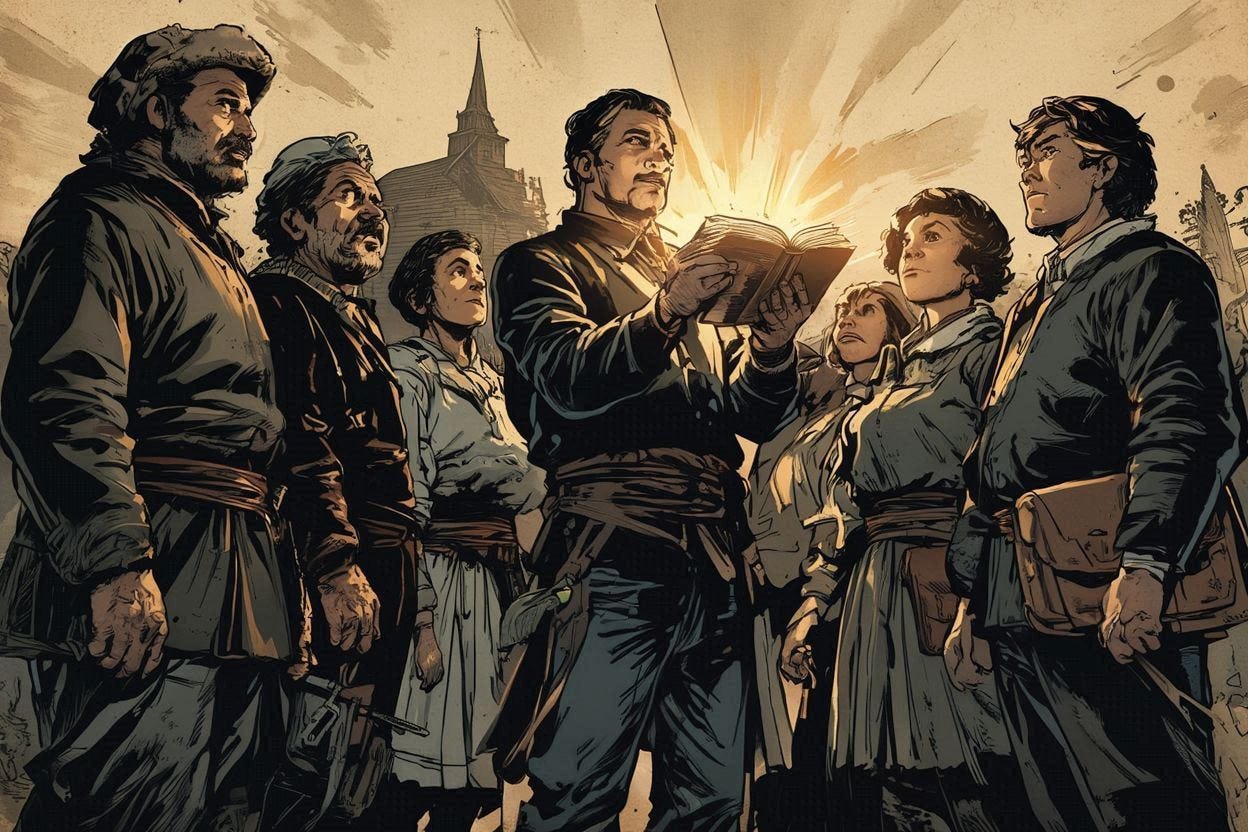
By elevating the authority of the Bible above the authority of the Church, the Reformers introduced the idea of the priesthood of all believers.
Through Scripture and prayer, the Reformers argued all believers have direct access to God. Rather than requiring a clerical intermediary who participates in mediation before God, they emphasized each believer is part of a holy and spiritual priesthood.
4 As you come to him, the living Stone—rejected by humans but chosen by God and precious to him— 5 you also, like living stones, are being built into a spiritual house to be a holy priesthood, offering spiritual sacrifices acceptable to God through Jesus Christ. [1 Peter: 2: 4 - 5]
It was a shift that encouraged old authority structures to be questioned and elevated a sense of personal responsibility.
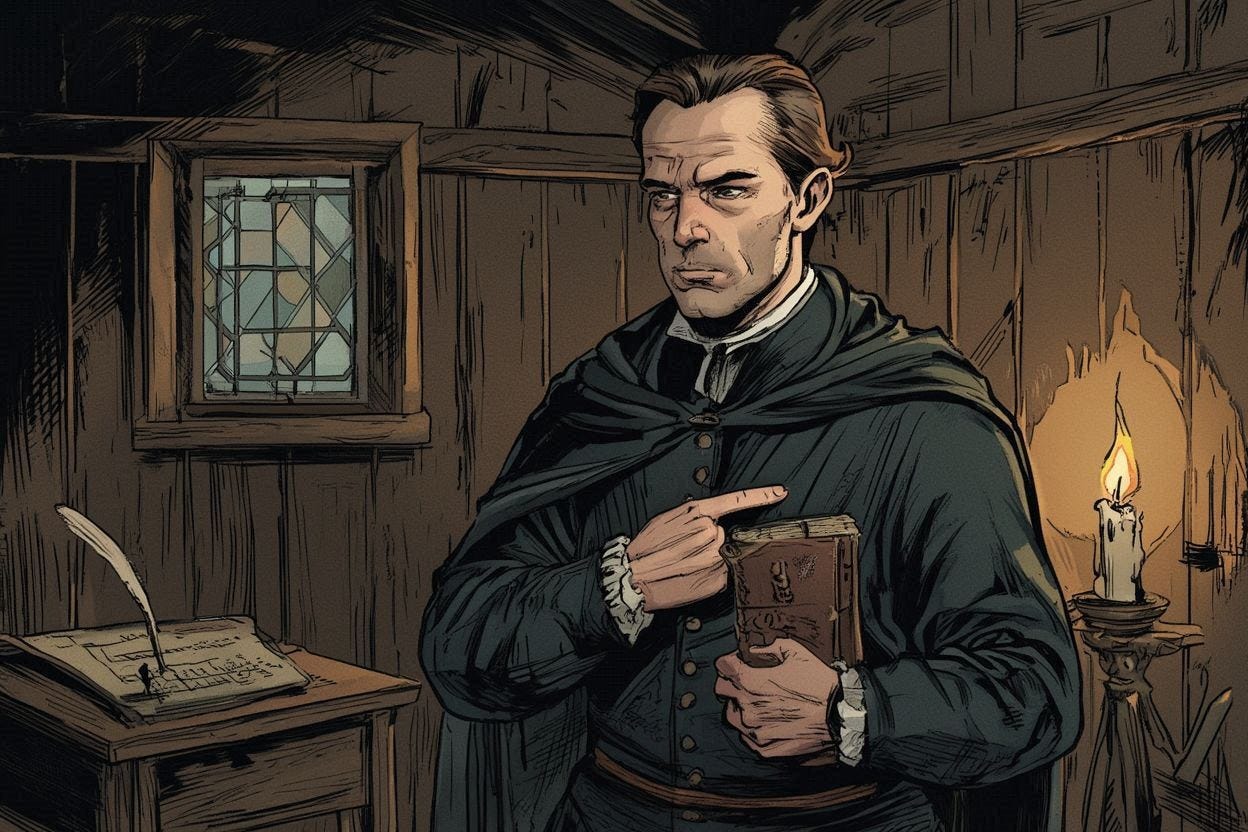
A man’s conscience suddenly seemed to matter more than it had before.
Because man would stand alone before God through Jesus.
5 For there is one God and one mediator between God and mankind, the man Christ Jesus, 6 who gave himself as a ransom for all people… [1 Timothy 2: 5 - 6]
These trends would manifest themselves in political ideas like limited government and individual rights.
The later development of representative democracy would come to flourish most in geographies with deep ties to the Reformation. That includes John Calvin’s homeland of Switzerland, Scotland, and the Netherlands.
And of course, the Puritan pilgrims would come to America as religious exiles who had a high view of individual liberty in matters of politics and religion.
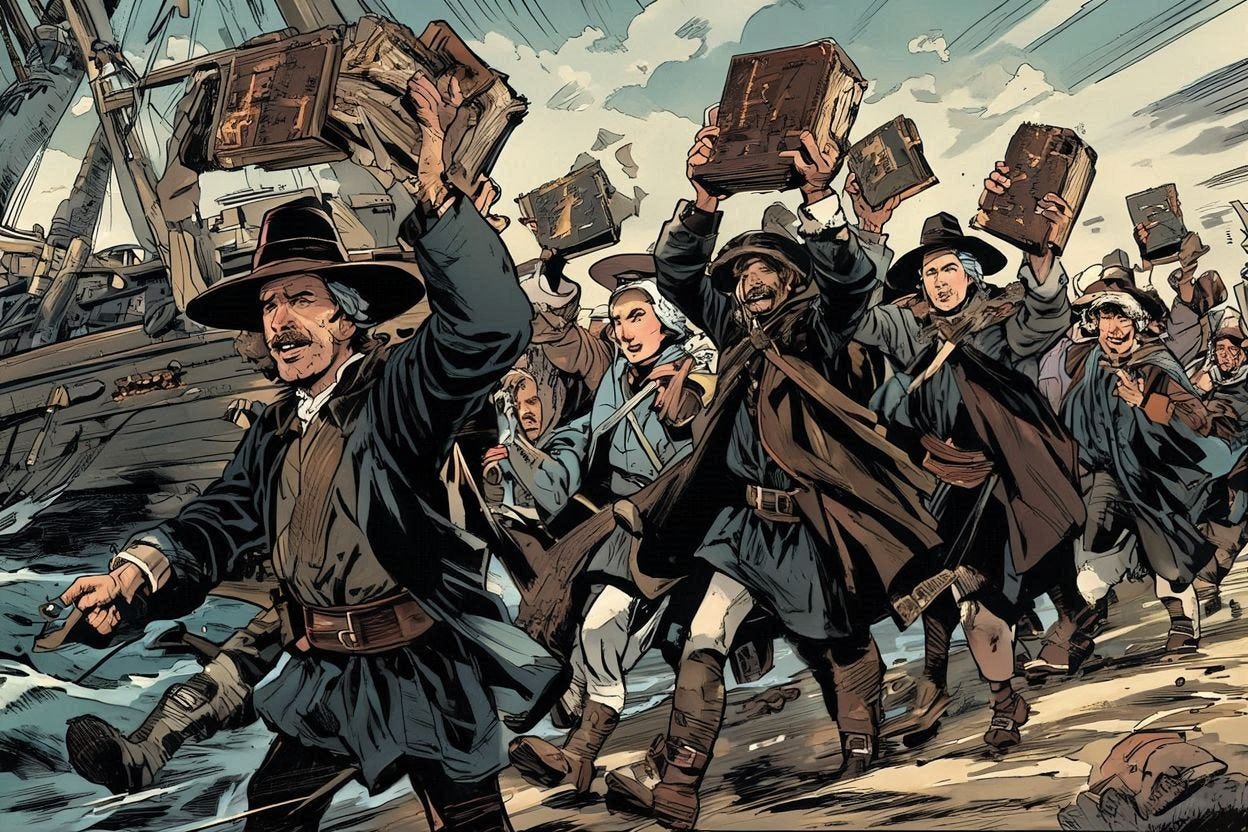
The Reformers didn’t set out to help establish democracy. Most of them were monarchists. But these democratic outcomes were the indirect results of their theological shifts.
Reform of Indulgences and Beyond in the Catholic Church (3)
"As soon as a coin in the coffer rings / the soul from purgatory springs."
That was the supposed sales pitch of Johann Tetzel, a 16th-century Dominican friar and the sub-commissioner for indulgences at Meissen, Saxony.8
Indulgences were tied to the idea of treasury of merit, the belief that the Catholic Church had a “superabundant” treasury of merits from the lives of Jesus Christ and the saints that could be applied to the faithful.


Indulgences were linked to the Council of Claremont in 1095, when Pope Urban II offered plenary indulgences to those who participated in the First Crusade.9 The indulgence was not thought to pardon sin but to remove the temporal purification required for sin.
In 1476 Pope Sixtus decreed that plenary (full) indulgences could be applied to the dead in purgatory, and they significantly increased in popularity.
By the 1500’s the popularity was looking far more like abuse, as agents of the church (“pardoners” or quaestores) were sent out to sell indulgences which had largely been available before only through spiritual acts. Some quaestores (like Tetzel) ignored the Church’s teaching about repentance, confession, and a proper heart posture, and wrongly sold indulgences as removal of all punishment or even as tickets for salvation.
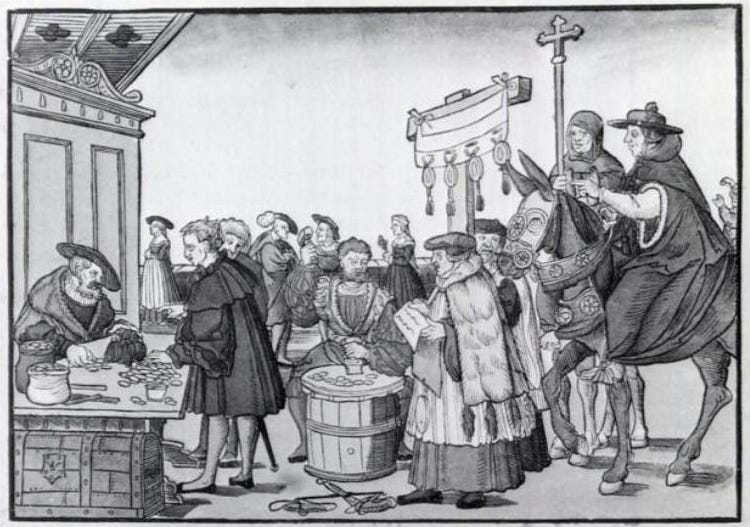

in Tetzel’s “sales” territory, proceeds indulgences were split 50 / 50 between Pope Leo X for St. Peter’s Basilica and local prince Albrecht of Brandeburg. Albrecht needed to use his money to pay off a loan he had secured to pay the Pope for the right to hold multiple ecclesiastical offices.
Luther’s accusations of indulgence corruption seemed hard to refute.
The Impact of the 95 Theses
The specific contentions outlined in the Ninety-Five Theses were all related to indulgences.
In fact, the piece itself was actually called Disputation on the Power and Efficacy of Indulgences.
Luther particularly objected to Tetzel’s approach, which tended to position indulgences as offering relief for souls in purgatory.
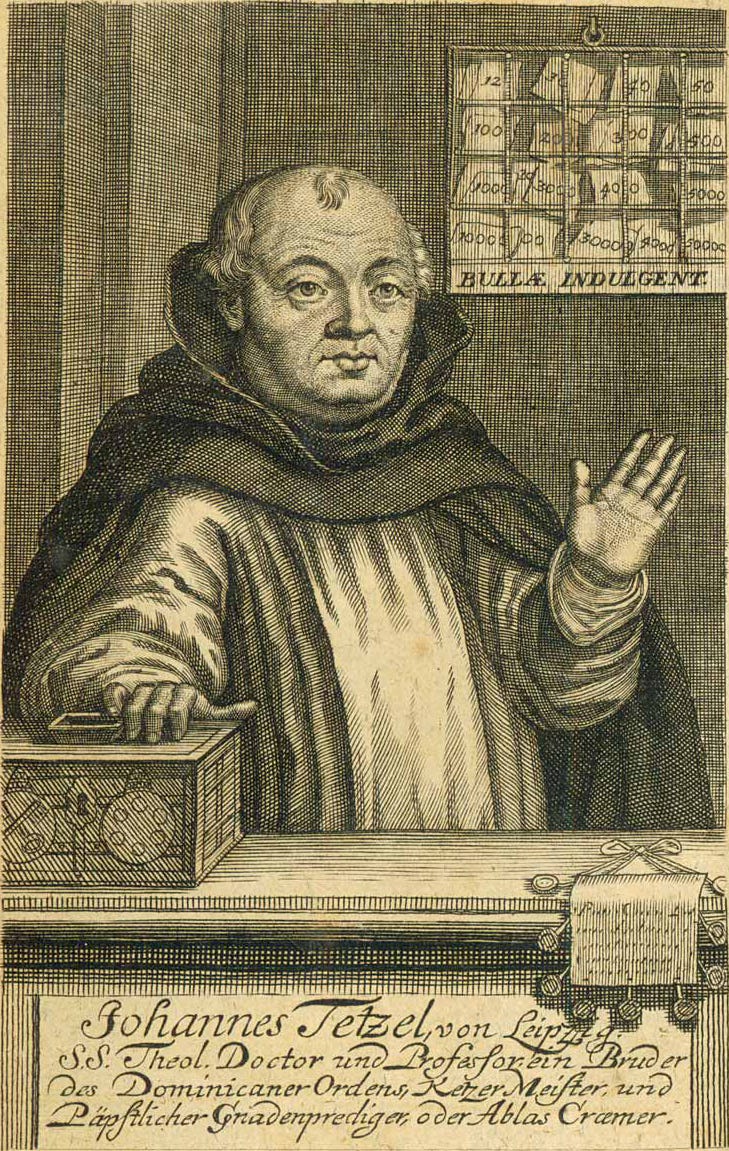

Luther argued that the Pope had no authority over purgatory (later, he would come to reject the doctrine of purgatory entirely), and said that the only true repentance was inward.
In his first thesis, he argues that the entire life of the Christian should be one of repentance.
Here are some of the other highlights.
Theses 94 and 95 exhort believers to follow the path of Christ through suffering rather than looking for “false security” in indulgences.
Thesis 89 asks why the Pope only now grants indulgences, implying that there are hidden motives and seemingly convenient theology behind their recent growth.
In Thesis 86 he accuses the papacy of greed. Why does not the Pope, a man with wealth “greater than the richest Crassus,” build the new cathedral with his own money rather than the money of the poor?
In Thesis 50 he rails against the methods of the indulgence sellers, arguing that if the Pope knew what was happening on the ground he would prefer to see St. Peter’s burn rather than have it built with “the skin, flesh, and bones of his sheep."

Initially, Pope Leo X attempted to ignore Luther. Then he moved to silence him.
Luther was formally condemned in on June 15, 1520 in a papal bull (Exsurge Domine) that detailed errors in Luther’s work and demanded a recantation.
When Luther didn’t recant and instead burned the bull in protest, he was excommunicated on January 3, 1521.
Luther may have been out of the Catholic Church, but his work led to the Catholic Counter Reformation, which was formalized in the Council of Trent (1545 - 1563).
Following Trent, the professional sale of indulgences was banned and other reforms related to clergy education, an increased emphasis on piety, administrative reform, and more were put in place.
The Separation of Church and State (4)
The separation of church and state was one of the most significant long term, indirect results of the Reformation.
The conflict with the Catholic Church in Rome meant that there needed to be a new framework for Protestants and the state to co-exist. Prior to the Reformation, there was no way to conceive of a church that was not deeply intertwined in the state structure and apparatus.
Two Kingdoms
Luther articulated his doctrine of “two kingdoms.” Other Reformers like Calvin espoused similar ideas and together they laid the groundwork for separating civil and spiritual power.10

According to Luther’s argument, God rules the state/civil law (the "kingdom of the world") differently than the Church / Gospel ("kingdom of God").
It was a whole new framework for separating salvation from government.
The Break With Rome
Because of the Reformation local rulers could break free from Roman Catholicism. There were now theological justifications to go along with the economic and political reasons that some monarchs had for desiring independence from Rome.
At first, this just meant that church and state were unified at the national level instead of the supranational papacy.
But in time this would lead to the development of religious freedom within a secular state. It’s important to note that this isn’t what the Reformers wanted. They wanted their own views to be the state-enforced religion, But it’s where things eventually moved (sadly, not without plenty of religious violence).
This is what we have now in the world.
We live in pluralistic societies where the government does not enforce religious conformity and all are free to choose their faith based on their own research and conscience.
A Win for Both Church and State
This is a strength for the state. Separation keeps the government from becoming a mechanism of religious coercion or persecution.
It’s especially good news for the church. It keeps religious faith from becoming an arm of the state apparatus, where spiritual stagnation and compromise tend to occur.
When church and state have been tied, history shows that the church can become a handmaiden to political power in corrupt and oppressive societies.
The Supremacy of Grace and Faith (5)
Luther helped set a vision of the Christian life that was deeply personal and utterly reliant on God’s grace.
He minimized the role of church hierarchy and tradition in salvation, and emphasized the centrality of Christ and the Cross. It was God’s grace, received by a true and lively faith, that made someone a Christian.
Scripture like the following passage from Ephesians defined this Reformation view.
8 For it is by grace you have been saved, through faith—and this is not from yourselves, it is the gift of God— 9 not by works, so that no one can boast. [Ephesians 2: 8 - 9]
What do Protestants Believe About Grace?
The Reformers believed that the Christian cannot save himself herself. The Christian cannot independently move towards God but is reliant on God’s grace.
Because of original sin, human beings are incapable of saving themselves through their own innate goodness or any merits they could achieve on their own.
Catholics affirm this same belief as well. And while some Catholics might bristle at this, they may owe the Reformers a debt of gratitude.
Because the Reformation led the Catholic Church to issue more clearly articulated views on faith and grace.
These clarifications were largely formulated at the Council of Trent. Abuses like the sale of indulgences were corrected and theology was clarified to emphasize that salvation is utterly dependent on God’s grace.
There are still crucial distinctions between Catholicism and Protestantism, of course.
Unlike the Reformers, Catholics would not say that salvation is only dependent on grace. Salvation is impossible without God’s grace according to Catholic teaching, and it also involves the cooperation of man’s will.
Yet the necessity and centrality of grace was emphasized for all followers of Christ.
Wrapping Up
Today most of us in the West are comfortable living in a world where freedom of conscience matters.
We have a hand in electing government officials.
We have access to information to make our own decisions.
We live in a world where most still believe separating church and state is a benefit for both institutions.
Some (hi, there) think the pendulum has swung too far and we’re hyperindividualistic, self-focused, and overloaded with choices and information.
But even if that’s our modern challenge, we have freedom to worship God (or not) as we choose. And for those of us who recognize that we are not cosmic accidents, we have access to Christian faith traditions that all emphasize our desperate need for God’s grace.
We can thank the legacy of Protestantism for helping bring that about.
*********
This article is part of a series on Christian unity.
*********
Part 1: Unity in the Body of Christ:
Part 2: 5 Ways to Pursue Unity in the Church
Part 3: The Regula Fidei and the Test of Christian Faith
➯ The Quartodeciman Controversy and the Regula Fidei
➯ The Gnostic Movement, Irenaeus, and the Regula Fidei
➯ Gnosticism vs. Christianity: 3 Big Differences
➯ Simon the Sorcerer, the Proto Gnostic
Part 4: Respect for the Catholic Church
➯ In Appreciation of the Orthodox
Protestantism by country: https://en.wikipedia.org/wiki/Protestantism_by_country
All Saints’ Church, Wittenberg: https://en.wikipedia.org/wiki/All_Saints%27_Church,_Wittenberg
Printing press: https://en.wikipedia.org/wiki/Printing_press
Martin Luther, his written works: https://museeprotestant.org/en/notice/martin-luther-his-written-works/
Selling the Reformation: https://www.christiancentury.org/reviews/2016-05/selling-reformation#:~:text=Luther%20and%20Cranach’s%20early%20modern,popular%20of%20his%20many%20publications
Martin Luther and the first best sellers: https://www.almosthistorypodcast.com/martin-luther-and-the-first-best-sellers/
Note: Following Vatican II (1962 - 1965) the Catholic Church officially teaches that the Magisterium is "not superior to the Word of God, but its servant". The pre-Reformation practical reality for most included a world where most of the laity could not read and the Church's decrees often superseded Bible reading in public life
Peddling purgatory relief: Johann Tetzel: https://www.ncronline.org/news/guest-voices/peddling-purgatory-relief-johann-tetzel
The Historical Origin of Indulgences: https://www.catholicculture.org/culture/library/view.cfm?recnum=1054#:~:text=3.,one%20or%20the%20other%20practice.
Two kingdoms doctrine: https://en.wikipedia.org/wiki/Two_kingdoms_doctrine
It is so powerful to see how everything we believe and practice is based on what came before. I am so thankful for Luther's courage and faith to call out the corruption that happens as a result of wealth and power..a cautionary tale for all time..especially today. And so thankful that he pointed us to scripture as the ultimate authority.